
Inflation headlines tend to flatten everything into one number. Bloomberg's Price Project, published November 2, 2026, is useful precisely because it does the opposite: it rebuilds a consumer price picture from millions of prices each month, covering about 87% of the CPI basket by spending weight, with most data updated daily or weekly rather than monthly.
Its headline reading for September was 4.4%, above the official CPI reading of 3.7% cited in the same piece. Underneath that headline, though, the details split in very different directions. Avocados are one of the clearest outliers.
The outlier in the grocery cart
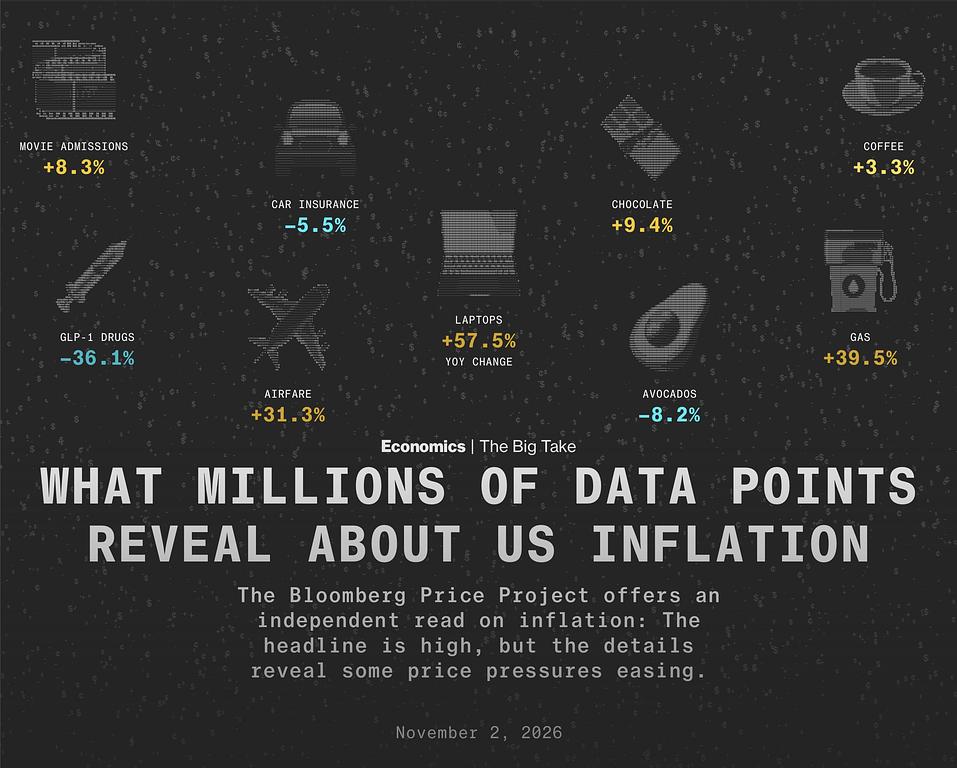
In Bloomberg's hero graphic, avocados are listed at -8.2% year over year.
That stands out against the broader grocery picture in the same project, where grocery stores overall were up 2.9% from a year ago. So this is not a story of food prices falling across the board. It is a story of one fresh item moving the other way while the grocery basket as a whole still rose.
What went up instead
The same graphic puts several familiar expenses sharply higher year over year:
- Laptops: +57.5%
- Gas: +39.5%
- Airfare: +31.3%
- Chocolate: +9.4%
- Movie admissions: +8.3%
- Coffee: +3.3%
Bloomberg gives drivers for some of these, but not all of them. For laptops and electronics, it points to memory-chip prices nearly doubling, along with tariffs and demand tied to the AI hardware build-out. For gas, it points to rising oil prices. For chocolate, movie admissions, and coffee, the piece gives the percentage only, with no separate explanation in the body text.
Not everything is rising
It would be wrong to say every other price is up. Two other categories in the same graphic fell:
- Car insurance: -5.5%
- GLP-1 drugs: -36.1%
Bloomberg links the car insurance drop to the fading post-pandemic accident surge and insurers having room to lower premiums, and the drug drop to policy changes and market competition. Its trimmed-mean reading, which sets aside the most extreme moves at both ends, was 2.2% through October — lower than the headline — which is the piece's way of showing some underlying pressure easing even while the headline stays high.
What this does — and does not — tell us about avocados
This is the part worth being careful about. In the Bloomberg piece, avocados appear only as a generic category label in the graphic. The piece does not name a variety, a unit, a store, or a region, and it does not mention avocados in the article body at all. It gives no driver for the -8.2% figure.
So the honest reading is narrow: in Bloomberg's category data, avocados were down 8.2% year over year. That is not the same as a verified national-average price for California Hass avocados, and it is not a price for any one farm, including ours. Fresh produce prices also move on a different rhythm than fuel or electronics, and a single year-over-year category figure does not tell you what any given grove received or what shoppers will see next month.
What it means from our grove in De Luz
From our family farm in De Luz, the contrast still matters, just not as a price promise. When a staple fresh item gets cheaper while travel, fuel, and tech get much more expensive, it is a reminder that inflation is not one uniform force. Households feel it in pieces, and the pieces do not all move together.
Our avocado season is done, and our Hass boxes are sold out at any quantity. If you want to hear when the next season opens, the place to join is our next-season waitlist at patelranch.com/reserve. That list is interest only, not a paid pre-order.
Keep reading
- Discover the Flavor of California Avocado Season
- Homemade Avocado Oil: Turning Storm-Fallen Fruit Into Liquid Gold at Patel Ranch
Source: Bloomberg Price Project, "What Millions of Data Points Reveal About US Inflation," November 2, 2026: https://www.bloomberg.com/graphics/2026-inflation-price-index/